
ACP Annual Conference Internal Medicine Meeting 2026 Rising Star Scholarship Program 体験レポート
2026年5月11日
東京科学大学病院 丹治文子
|
|
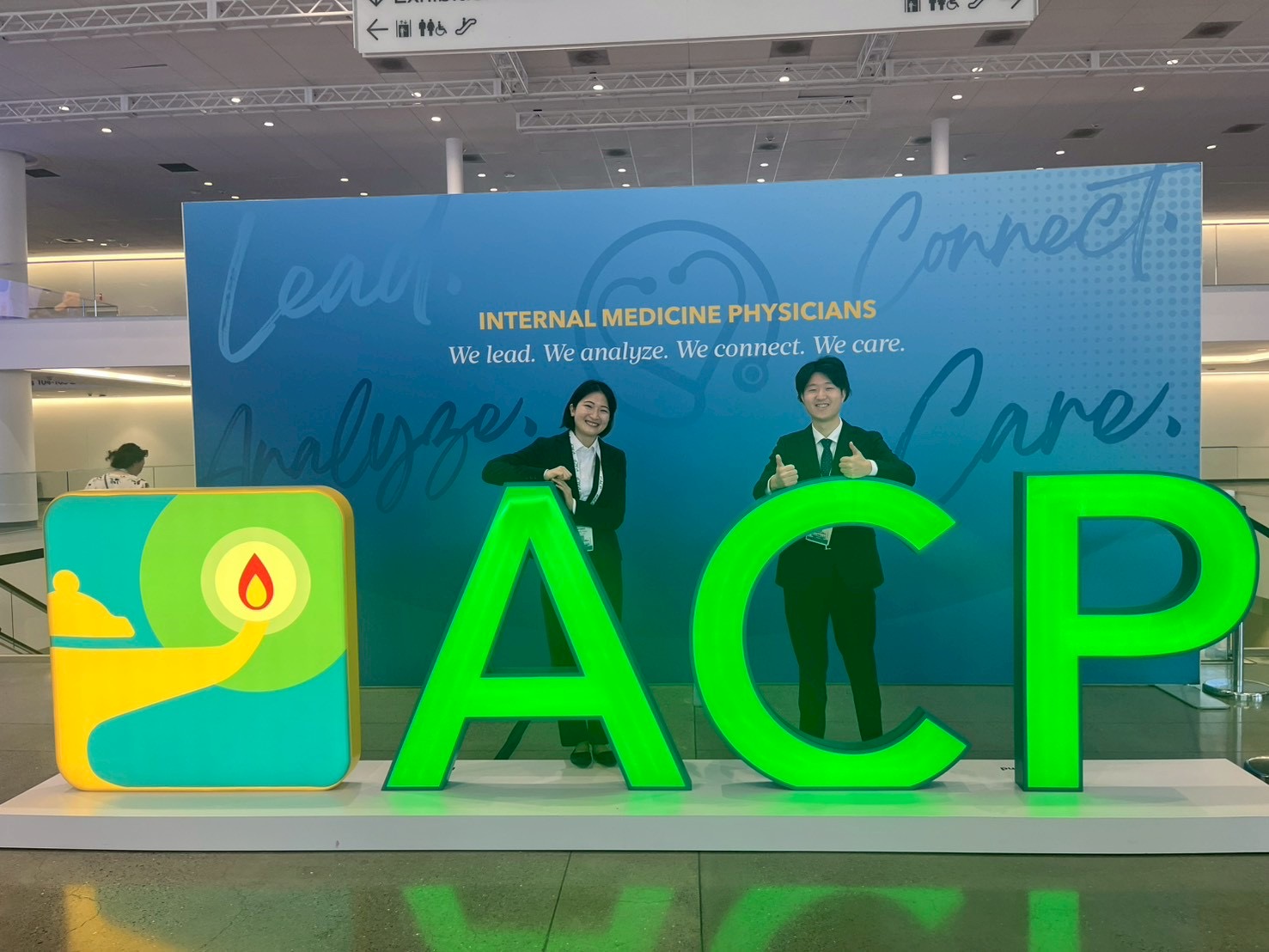
この度、2026年度Rising Star Scholarship ProgramのAwardeeとして、米国San Franciscoで開催されたACP Internal Medicine Meeting 2026および、カナダCalgaryでのPoint-of-Care Ultrasound (POCUS) 研修に参加させていただきました。
<Pre-course: 4/14-15>
Pre-courseでは、「Nutrition in Practice: Evidence-Based Strategies for the Internal Medicine Physician」と「Cardiology for the Internal Medicine Physician 2026: “The Key Points”」のコースを受講し、8時から17時まで講義を受けました。NutritionではCulinary Medicine、サプリメント、低栄養、肥満・糖尿病に対する食事療法、経腸・静脈栄養、微量栄養素欠乏などが含まれており、特に情報にあふれた現代において、医療者が普段からエビデンスに基づいた栄養に関する正確な知識を患者に伝えることの重要性を感じました。Cardiologyでは急性冠症候群、心房細動、心不全、術前心血管評価、心臓画像、弁膜症、高血圧、心電図異常など、内科医が日常診療で頻繁に遭遇するテーマを整理し直すことができました。どちらのコースでも、ガイドラインの推奨度やRCTなどの根拠を示しながら講義が進められていたことが印象的でした。
<ACP総会 2026: 4/16-18>
本会では、AIに関するセッションが数多く設けられていました。OpenEvidenceはUSMLEで100%の正答率であり知識面でAIに勝つのは難しい一方で、それでも多くの人々は人間の医師に診てもらいたいと考えているという議論もあり、医師の価値を改めて考えさせられました。業務効率化のためのAIの使用によりバーンアウトが防げること、患者のためのAIツールの発達など、様々な視点から今後AIが医療においてどのような役割を果たすかが考察されていました。
また、身体診察のブースでハンズオンの講義を受けた際には、Frameworks for Internal Medicine の著者であるDr. André Mansoorに直接JVPの診察について教わりました。聖路加国際病院の指導医が彼と同じ木製のベル型の聴診器の使用を推奨しており、自分も持っていることをお伝えしたところ、大変驚いておられました。講義内容も素晴らしく、Physical Diagnosis PDXやStanford Medicine 25といったサイトには同様の身体診察の動画が豊富に掲載されているため、今後も参考にしつつ研鑽を続けようと思いました。
その他にもACP本会では多くの出会いがあり、セッション中に隣に座った先生が何気なく話しかけてくださり、そのまま名刺交換につながることもありました。学会は講演を聴くだけの場所ではなく、同じ関心を持つ医師と出会い、将来のキャリアにつながる関係を築く場でもあるのだと実感しました。Rising Star Scholarship Programを通じてこのような環境に身を置けたことは、今後国際的な場で学び続けるうえで大きな励みとなりました。
<University of Calgary POCUS研修:4/20-24>
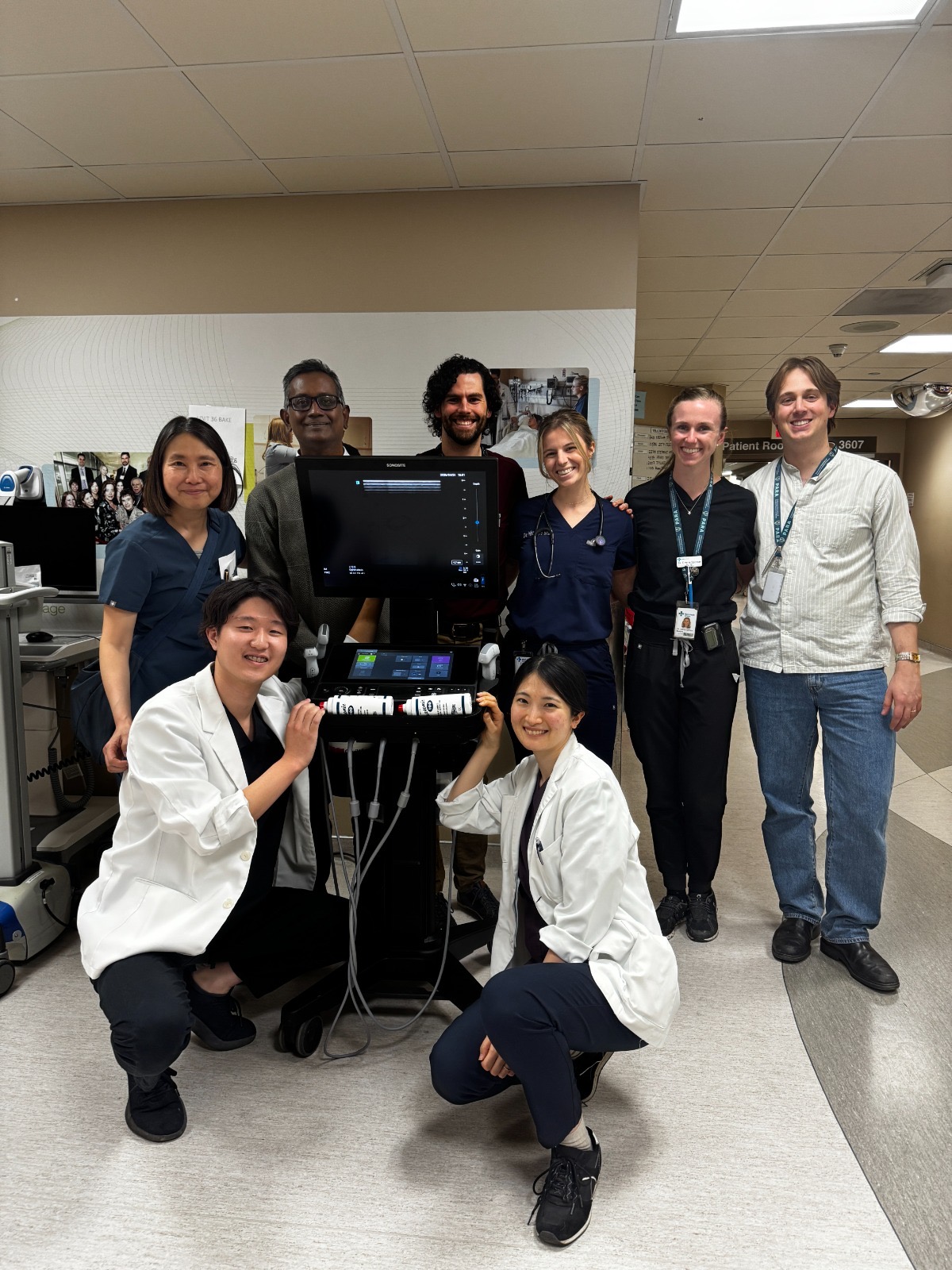
ACP後には、CalgaryのFoothills Medical Centreにて、Dr. Irene Ma先生率いるPOCUS teamで研修をさせていただきました。私はこれまで日常診療の中でエコーを使用する機会は多くありましたが、十分に理解しきれないままプローブを当てていた場面もありました。今回の研修では、Dr. Maがエコーの内部構造、プローブの当て方、各臓器で注意すべきピットフォール、そして所見をどのように臨床判断につなげるかまで、非常に体系的に教えてくださいました。コンサルトを受けた患者さんに応じて、その場で100以上あると思われるレクチャーから関連するものを選んで指導してくださる教育スタイルは大変贅沢で、毎日が新しい学びに満ちていました。POCUSは単なる検査ではなく、患者背景を理解した医師が行うことにより、必要な情報を集め、次のステップ(Volume評価の場合は補液/利尿など)を決めるためのアセスメントができるのだと感じました。JVP、肺、心臓、IVC、腎臓、下肢静脈、関節など幅広い領域のPOCUSを経験させていただきました。POCUSはGeneralistにとって親和性の高い領域であり、自分もさらに学びを深めたいという気持ちが強まりました。
私は2026年7月からMount Sinai Morningside/Westで内科研修を開始する予定です。今回のACPおよびCalgaryでの研修は、自分がどのような内科医を目指したいのかを再確認する機会となりました。米国での研修では、臨床能力はもちろん、POCUS、身体診察、医学教育、そしてGeneralistとしての幅広い視点をさらに深めていきたいと考えています。そして将来的には、米国で得た学びを日本に還元し、日本の総合内科の発展に貢献してまいります。
最後になりますが、このような貴重な機会を与えてくださったACP日本支部長の矢野晴美先生をはじめ、ACP日本支部の先生方、Rising Star Scholarship Programに関わってくださった皆様、Calgaryで温かく迎えてくださったDr. Irene Ma先生とPOCUS teamの皆様、そして日々支えてくださっている職場の先生方・同僚の皆様に、心より感謝申し上げます。今回の経験を今後の臨床、教育、そして国際的なキャリア形成につなげていけるよう、引き続き努力してまいります。
Ayako Tanji
Institute of Science Tokyo Hospital
|
|
|
I was truly honored to be selected as an awardee of the 2026 Rising Star Scholarship Program, which gave me the invaluable opportunity to attend the ACP Internal Medicine Meeting 2026 in San Francisco, as well as to participate in Point-of-Care Ultrasound (POCUS) training in Calgary, Canada.
<Pre-course: April 14–15>
For the pre-course, I attended two sessions: “Nutrition in Practice: Evidence-Based Strategies for the Internal Medicine Physician” and “Cardiology for the Internal Medicine Physician 2026: ‘The Key Points.’” Both courses were full-day lectures from 8 a.m. to 5 p.m. The Nutrition course covered a wide range of topics, including culinary medicine, supplements, malnutrition, dietary approaches for obesity and diabetes, enteral and parenteral nutrition, and micronutrient deficiencies. The course reminded me of the importance of providing patients with accurate, evidence-based nutrition information in everyday clinical practice, especially in this era when patients are surrounded by an overwhelming amount of health-related information. The Cardiology course allowed me to review and update my knowledge on topics that internists frequently encounter in daily practice, such as acute coronary syndrome, atrial fibrillation, heart failure, preoperative cardiovascular evaluation, cardiac imaging, valvular heart disease, hypertension, and ECG abnormalities. In both courses, it was notable that the speakers consistently referred to guideline recommendations, randomized controlled trials, and other forms of evidence to support their teaching.
<ACP Internal Medicine Meeting 2026: April 16–18>
During the main ACP meeting, I was impressed by the large number of sessions related to Artificial Intelligence. OpenEvidence was introduced as having achieved a perfect score on the USMLE, which made me realize how difficult it will be for physicians to compete with AI in terms of knowledge alone. At the same time, there was also discussion that many people still prefer to be cared for by human physicians, which made me reflect on the true value of physicians. The sessions explored the future role of AI in medicine from various perspectives, including its potential to reduce physician burnout through improved efficiency and the development of AI tools designed for patients.
A particularly memorable moment was learning directly from Dr. André Mansoor, the author of Frameworks for Internal Medicine, about the examination of jugular venous pressure at a hands-on physical examination session. He was very surprised when I shared that, at St. Luke’s International Hospital, one of my mentors recommends using the same wooden bell stethoscope as Dr. Mansoor, which I actually use in daily practice. His teaching was excellent, and I was also reminded that resources such as Physical Diagnosis PDX and Stanford Medicine 25 provide many valuable videos on physical examination. I hope to continue learning from these resources and further refine my bedside examination skills.
Beyond the sessions, I had many meaningful encounters throughout the ACP meeting. On several occasions, physicians sitting next to me during sessions casually started conversations, which naturally led to exchanging business cards. This made me realize that conferences are not only places to listen to lectures, but also valuable opportunities to meet physicians with shared interests and to build relationships that may shape one’s future career. Being able to place myself in such an environment through the Rising Star Scholarship Program was deeply encouraging as I continue to pursue learning in international settings.
<University of Calgary POCUS Training: April 20–24>
Following the ACP meeting, I had the privilege of joining the POCUS team led by Dr. Irene Ma at Foothills Medical Centre in Calgary. Although I had used ultrasound frequently in my daily clinical practice, there had been many occasions when I placed the probe without fully understanding the underlying principles or confidently interpreting the findings. During this training, Dr. Ma taught us in a highly structured way, beginning with the basic physics of ultrasound machines, probe handling, organ-specific pitfalls, and how to integrate ultrasound findings into clinical decision-making. Depending on the patients referred to the POCUS team, she would select relevant lectures from what seemed to be more than 100 teaching materials and teach us on the spot. Every day was filled with new learning. Through this experience, I came to understand that POCUS is not merely a diagnostic test. Rather, when performed by a physician who understands the patient’s clinical background, it becomes a powerful bedside tool for gathering essential information and guiding the next step in management. During the training, I had the opportunity to experience a wide range of POCUS applications, including JVP, lung, cardiac, IVC, renal, lower-extremity venous, and joint ultrasound. I felt that POCUS is highly compatible with generalist practice, which further motivated me to continue deepening my skills in this field.
I will begin my internal medicine residency at Mount Sinai Morningside/West in July 2026. Together, ACP and the POCUS training gave me an important opportunity to reflect on the kind of internist I hope to become. During my residency in the United States, I hope to further develop not only my clinical skills, but also my abilities in POCUS, physical examination, medical education, and broad generalist thinking. In the future, I hope to bring what I learn in the United States back to Japan and contribute to the development of general internal medicine.
Finally, I would like to express my deepest gratitude to Dr. Harumi Gomi, all members of the ACP Japan Chapter, Dr. Irene Ma and the entire POCUS team in Calgary, and my supervisors and colleagues who support me every day. I will continue to work hard so that this experience will shape my future clinical practice, teaching, and international career development.